From the mainframe to Microsoft 365: 32 plugins, one platform
Ask a backup vendor "what do you protect?" and the honest answer is usually a short list plus a price sheet: the two or three workloads they do well come in the box, and everything else — the database engine you actually run, the hypervisor you just migrated to, the SaaS suite where your email really lives — is a paid add-on module, licensed per workload, quoted separately. The gaps only surface the day you need to restore.
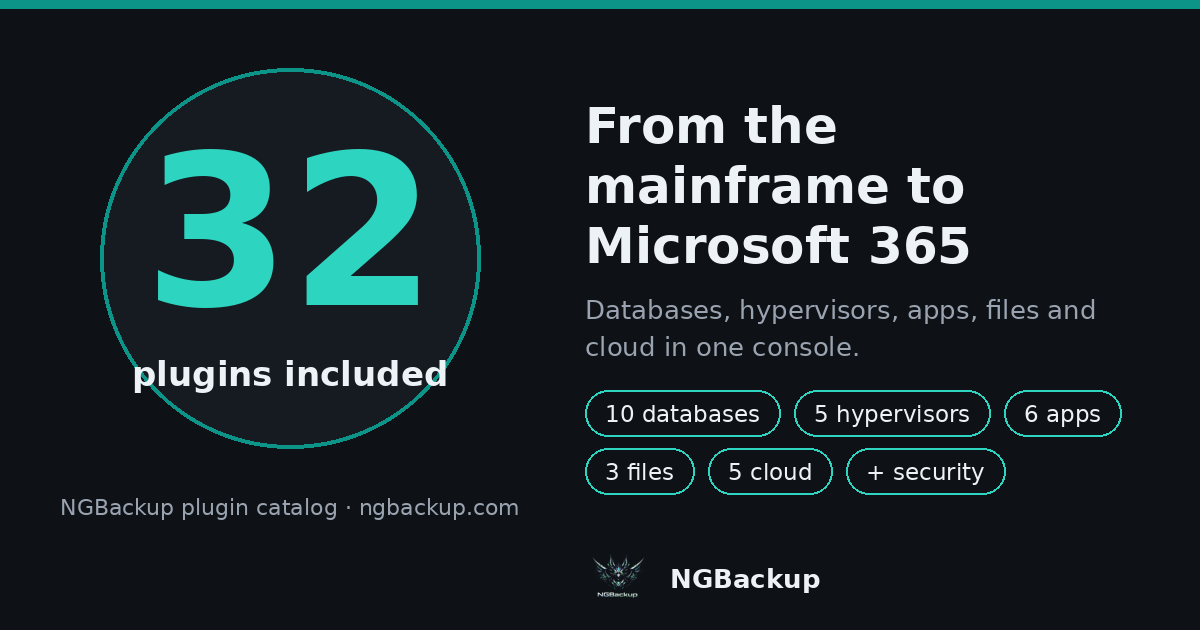
NGBackup takes the opposite position. 32 plugins ship included, spanning the full stack from a 40-year-old mainframe database to yesterday's Microsoft 365 tenant — and they all write the same self-indexing image format and restore from the same web console. Here is the whole catalog, by category.
10 database plugins
Databases are where backup tools quietly fall short — a filesystem copy of a running database is not a restorable backup. Each NGBackup database plugin talks the engine's own consistent-backup mechanism, not a file copy:
- Oracle Database — native RMAN integration, block-level incrementals and differentials, point-in-time recovery. No hand-written RMAN scripts.
- Microsoft SQL Server — full / differential / incremental with transaction-log and point-in-time recovery, and automatic database discovery across instances.
- PostgreSQL — dump and PITR modes, capturing tablespaces and roles automatically.
- MySQL / MariaDB / Percona — lock-free binary backups, single-table restore, point-in-time recovery.
- MongoDB — cluster-aware, replica-set and sharded-cluster safe, with consistent snapshots across nodes.
- Firebird — gbak-integrated consistent dumps, online or offline.
- IBM Informix — instance-aware online and offline backup.
- Software AG ADABAS and Progress / OpenEdge — the legacy and vertical-market engines most vendors simply do not list.
- SAP HANA — native Rust Backint agent and hdbsql-driven backup, validated against HANA 2.0 SPS08 (topology, backup, catalog and recovery).
5 virtualization plugins
Every hypervisor plugin is agentless — nothing installed inside the guests — and every one writes the same image format that Granular Restore and cross-hypervisor V2V read:
- VMware vSphere — agentless, CBT-based incrementals.
- Microsoft Hyper-V — image-level backup.
- Proxmox VE — the KVM platform enterprises are migrating to.
- Nutanix AHV — hyperconverged, first-class.
- Apache CloudStack — the open cloud-orchestration stack, rarely covered elsewhere.
Because they share one format, a VM backed up on VMware can be restored onto Proxmox — the migration path off a licensing squeeze is a restore job, not a project.
6 SaaS & application plugins
Your data leaving your datacenter does not mean it stops being your responsibility. The application plugins pull cloud data back into your storage:
- Microsoft 365 — Exchange Online, OneDrive, SharePoint and Teams into storage you control.
- Google Workspace — cloud-to-cloud for Gmail (full-fidelity .eml, labels preserved), Drive, Calendar and Contacts. Bacula Enterprise's equivalent covers only Gmail and Drive.
- HCL / Lotus Domino & Notes — the mission-critical groupware that never quite goes away.
- Active Directory & LDAP — the identity backbone you cannot afford to lose.
- Microsoft Exchange Server (on-premises) — mailbox databases on Exchange 2016, 2019 and Subscription Edition, with DAG passive-copy selection and Recovery Database restores.
- Microsoft SharePoint Server (on-premises) — consistent farm backup, with the content databases in SQL Server, and granular site, list and item recovery.
3 file & storage plugins
- SFTP — protect a remote endpoint over nothing but an SSH login.
- File Replication (BRC) — real-time replication for near-zero restore time.
- HPC Backup — parallel-filesystem backup at research-cluster scale.
5 cloud plugins
The cloud shows up two ways: as a workload to protect and as a backup target.
- Oracle OCI Compute — Oracle Cloud instances: boot and block volumes plus the metadata to relaunch them, full, incremental and differential backups, and full instance restore.
- AWS S3 — native driver that also serves any S3-compatible object store.
- Oracle OCI Object Storage — native, Oracle-validated driver with OCI API-key authentication.
- Azure Blob Storage — native driver with Shared Key authentication.
- Google Cloud Storage — native JSON-API driver with service-account authentication.
WORM immutability and ransomware detection travel with the data to every supported cloud.
The security layer, on every plugin
Three capabilities are not workloads but properties of the whole catalog: Granular Restore (file-level restore, Instant Recovery and cross-hypervisor V2V from any image backup), active Ransomware Detection, and global deduplication (source-side and storage-side, 20× typical and 60× seen in the field). They apply to whatever the 25 data-source plugins capture — you do not buy them per workload.
Why "included" is the whole point
The competitor model is to sell you the base product and then meter every workload: an Oracle module here, a VMware module there, a Microsoft 365 add-on, each with its own SKU and its own renewal. NGBackup's licensing is by agent, by TB, or MSP — all 32 plugins are in the box, with immutability and ransomware detection standard, at roughly half the total cost of Veeam. The workload you forgot to budget for is one you already have.
Browse the full plugin catalog, get the software, or book a free POC and back up the workload your current tool made you pay extra for.